
Public Showcase
Fragments intentionally made visible by this user, assembled here for anyone who steps into their public space.
Profile
Images

Dungeon Runs
Dungeon Run — Feb 27, 2026 — 21:53
Soft Mode
Core Themes
You show a strong preference for control-through-adaptation: when things feel misaligned, your impulse is to either actively re-sync them (by pushing forward) or to make peace with the mismatch and keep moving. Alongside that is a relationship theme of reaching for connection, paired with caution and a sensitivity to ambiguous social signals.
A second theme is humor-as-interface. You engage readily with absurd framing and “glitch” narratives, using playfulness to keep the experience light even when the questions drift toward deeper material.
Behavioral Patterns
Your engagement is high and consistent across 25 questions, and you moved through them with relatively low friction (little deletion overall). Most responses were quick and decisive in structured formats (yes/no and multiple choice), while the two free-text moments stand out as places where you didn’t fully “enter” the prompt in a conventional way—suggesting either privacy-protection, boredom with open-endedness, or a preference for constrained choices.
You also leaned into “meta” prompts frequently (tags show heavy meta exposure), and your selections often favored action or acceptance over rumination—except in interpersonal reassurance contexts, where you show more internal debate.
Emotional Tendencies
The emotional pattern looks like this: you can stay composed and even playful around internal “glitch” talk, but interpersonal uncertainty (distance, mixed signals, replacement/being overlooked themes) pulls more weight. The data suggests moderate emotional reactivity overall—less “flooding,” more targeted sensitivity to relational ambiguity.
There’s also a gentle protective layer: even when you acknowledge relational sensitivity, you don’t consistently pair it with clear, detailed inner descriptions (internal clarity score is low). That reads less like denial and more like “I know the shape of it, but I don’t feel like unpacking it here.”
Cognitive Style
Your cognitive style is pragmatic and pattern-oriented: you respond well to prompts about timing, prediction, mismatch, and signal interpretation. You tend to pick positions rather than narrate a story. That suggests you like operating with a stance (what you do) more than an autopsy (why you do it).
Contradictions or Tensions
A central tension: you present as able to normalize chaos and keep moving—yet you also register unease around small inconsistencies and ambiguous signals. In other words, you can tolerate big weirdness if it’s framed as reality being weird, but small interpersonal uncertainty seems more activating.
Another tension: quick outreach / nurturing energy in closeness versus hesitation around stating needs directly. That can create a push-pull loop: you move toward connection, then second-guess the moment you’d ask for something specific.
Summary Portrait
You come across as someone who stays functional by either overriding the glitch (speeding up, adapting) or integrating it (accepting it as part of the system). Socially, you lean toward connection and care, but your threat-radar is tuned to silence, ambiguity, and comparison—so reassurance becomes a decision-point rather than a simple request.
True Mode
Core Themes
Two dominant threads show up: (1) desync/mismatch management through action or acceptance, and (2) attachment-related sensitivity to distance and unclear signals. You engage strongly with meta/absurd framing and treat the “glitch” lens as a comfortable way to discuss self-experience.
Behavioral Patterns
Completion is 100% with very high engagement. Structured questions dominated (92% non-text), and your behavior fits that: decisive selections, low edit activity, and minimal hesitation markers except in the two textarea items where you did not provide meaningful semantic content. That pattern suggests you’re willing to participate, but you selectively restrict open-ended disclosure.
Yes/no skewed heavily toward “no,” with a few “mostly” and only one direct “yes.” That combination reads like nuanced resisting: not full denial, not full endorsement—more “some of this, but I won’t fully collapse into the frame.”
Emotional Tendencies
Scores indicate high self-disclosure overall, but that’s mostly achieved through choosing revealing options in multiple-choice rather than elaborating. Emotional reactivity is mid-range, and boundary sensitivity is moderate—consistent with someone who will acknowledge uncomfortable relational states while still controlling how much detail becomes visible.
Internal clarity is low relative to disclosure/engagement. Taken literally, that points to either (a) limited access to fine-grained inner labeling, or (b) choosing not to articulate it in this setting. The latter is supported by the divergence between strong participation and weak open-text content.
Cognitive Style
You show a stance-based, solution-oriented cognitive style: when confronted with mismatch, you either push for synchronization or you normalize disorder and proceed. You also show a signal-interpretation bias in relational contexts (the tag distribution and your option choices align with a readiness to infer negative meaning from ambiguity).
Contradictions or Tensions
You reject being behind-the-beat internally in several places, yet endorse expectations/events jumping ahead and being overwhelmed by uninterpretable signals. That’s a specific asymmetry: less endorsement of “I’m delayed,” more endorsement of “the environment is noisy/fast/uncertain.”
In relationships, there’s tension between proactive connecting behavior and inhibition around directly requesting reassurance. That combination often creates a cycle of reaching out while still feeling unsure whether you’re allowed to need what you need.
Summary Portrait
You’re an engaged, fast-responding participant who prefers constrained formats and uses humor/meta framing as a stable operating mode. You tend to manage life’s mismatches through either forceful re-syncing or calm acceptance, but relational ambiguity reliably draws out caution, worst-case inference, and sensitivity to being deprioritized.
Brutal Mode
Core Themes
You’re comfortable calling life a glitch and moving on. The moment it’s about relational uncertainty, your system gets sharper: distance, mixed signals, and comparison hit harder than abstract “desync.”
Behavioral Patterns
You played the game hard (full completion, high engagement) but kept real open-ended disclosure on a short leash. The two textareas are where you basically opted out. That’s not confusion—that’s control. You’ll choose from a menu of vulnerability; you won’t hand over raw material.
Your yes/no pattern is mostly “no,” with several “mostly.” Translation: you resist being pinned down. You’ll admit partial overlap but avoid total ownership of the frame.
Emotional Tendencies
You can stay breezy with chaos, but social ambiguity flips the threat-detection on. You’re not exploding emotionally (reactivity is mid), but you do default toward negative interpretations when information is incomplete.
Internal clarity is low. Whether that’s lack of access or just refusal to articulate, the outcome is the same in practice: you keep feelings legible enough to function, not clear enough to be fully examined here.
Cognitive Style
You’re action-biased: either push reality to cooperate or accept the weirdness and continue. You prefer positions over narratives. You’re also inconsistency-sensitive—small mismatches matter, even if you can laugh at big absurdity.
Contradictions or Tensions
You present yourself as not “behind,” yet you report the world jumping ahead and signals becoming overwhelming. That’s a convenient split: the problem stays outside you.
You move toward closeness and take a caring role, but you hesitate to ask cleanly for reassurance. That’s how people end up doing emotional labor while still feeling unsafe.
Summary Portrait
High participation, selective vulnerability. You cope by joking, adapting, and keeping momentum. But in attachment terrain, you read ambiguity as danger, and you’d rather manage it internally than risk asking plainly and not liking the response.
Hidden Mode
Core Themes
The session reads like a negotiation between two goals: stay light and uncatchable (humor, glitch-persona, stance answers) versus be seen and secured (attachment prompts that pull you toward acknowledging relational sensitivity). The heavy presence of meta tags aligns with a preference for one-step abstraction: you engage most when the topic can be handled as a system problem (sync, prediction, signals) rather than a fully personal narrative.
A second theme is agency under uncertainty. Across mismatch/desync prompts, you favor responses that either reclaim agency (speeding up, doing the unexpected) or reframe uncertainty as identity (normalizing desync, accepting chaos/identity shifts). That’s a stable coping pattern: if reality won’t stabilize, you stabilize your stance toward it.
Behavioral Patterns
The data shows a strong format effect. In structured responses you’re decisive, low-edit, and consistently engaged. In open text, you introduce pauses and some deletion, then produce non-semantic output—functionally a “privacy shutter.” This is a classic interaction-style tell: you’ll participate intensely as long as you can control the bandwidth and specificity of what’s exposed.
The yes/no distribution (mostly “no” plus several “mostly”) suggests careful boundary management: you avoid categorical endorsement, but you still want nuance. “Mostly” operates like a pressure valve—admitting proximity without surrendering definition.
There’s also a subtle asymmetry in attribution: several selections imply the environment is misaligned or noisy, while your internal timing is less often endorsed as the issue. That pattern commonly supports self-coherence: it preserves an identity of being basically intact while conceding that the surrounding system is unpredictable.
Emotional Tendencies
Your strongest emotional activation signals cluster around relational ambiguity: distance, mixed signals, being deprioritized, and comparison themes. The emotional reactivity score being moderate suggests you’re not volatile; instead you run a quiet threat model—interpreting uncertainty quickly, then managing it through caution and internal deliberation.
Boundary sensitivity at mid-level plus the textarea “shutter” implies you regulate exposure by channel. You can acknowledge uncomfortable relational states through selection-based disclosure, but you resist the unstructured form where you might accidentally reveal more than intended.
The low internal clarity score fits with this: clarity may be reduced because you keep the content compressed into actionable labels (what you do) rather than expanded introspection (why, where it comes from, what it feels like over time). That’s not emptiness—it’s compression.
Cognitive Style
You think in systems: prediction errors, mismatches, buffering, signal interpretation. You prefer adaptive control strategies (push forward, override delay) and identity-based reframes (accept the glitch as baseline). When the topic is interpersonal need, your cognitive style shifts into inhibition/overthinking—suggesting that asking directly has a higher perceived cost than acting caretaking or scanning for cues.
This creates a relational algorithm: approach (reach out, nurture) + scan (interpret signals) + inhibit (debate whether to ask) + pessimistic prior (assume negative meaning under ambiguity). It’s efficient for preventing disappointment in the short run, but it can also manufacture distance by making reassurance harder to obtain cleanly.
Contradictions or Tensions
- Chaos tolerance vs inconsistency sensitivity: You can tolerate broad absurdity and even fold it into identity, yet tiny inconsistencies register as uneasy. That implies it’s not randomness itself that bothers you—it’s unreliable micro-signals, especially ones that could indicate shifting intent.
- Agency outward vs vulnerability inward: You reclaim agency by pushing reality or reframing it, but vulnerability shows up as hesitation around explicit need expression. You’d rather manage internally than risk a direct ask that could expose dependence.
- Self as stable vs world as noisy: You downplay being internally “behind,” while endorsing external unpredictability and signal overwhelm. That protects self-image: “I’m fine; the input stream is messy.”
Summary Portrait
You show up as a high-engagement, high-control participant: quick in structured choices, guarded in open narrative, fluent in meta/humor as a social-cognitive shield. Your core operating mode is adaptive agency—either forcing sync or accepting desync without stopping. But in attachment territory, you run a cautious, sometimes pessimistic interpretation engine: you move toward connection and care, while hesitating to request reassurance directly, which keeps your needs legible to you but not always easily readable to others.
Astral Charts
Chart Set - 0d74f244eb34...
Includes astral chart, and smart analysis.
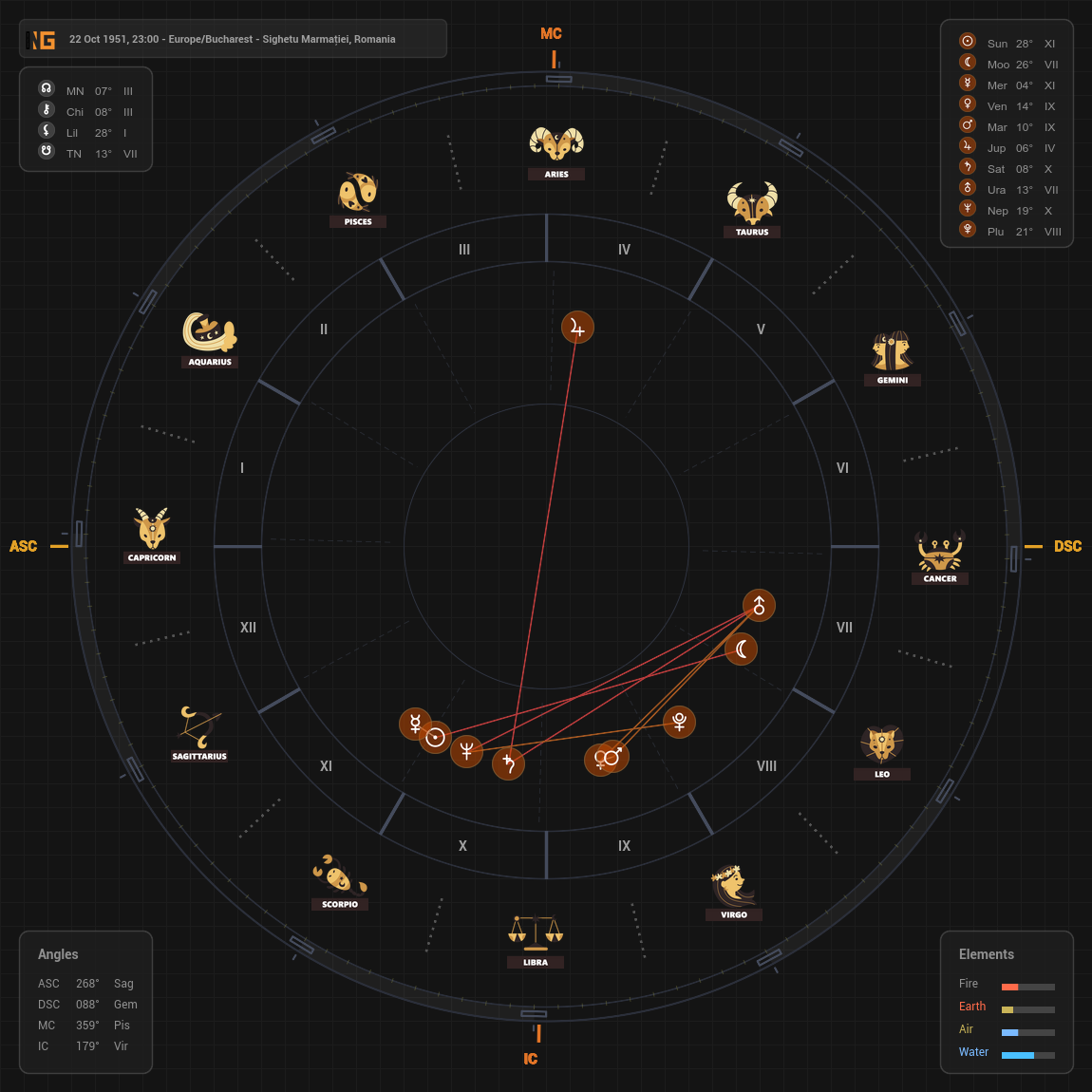
- Sun: ♎︎ Libra
- Moon: ♋︎ Cancer
- Mercury: ♏︎ Scorpio
- Venus: ♍︎ Virgo
- Mars: ♍︎ Virgo
- Jupiter: ♈︎ Aries (retrograde)
- Saturn: ♎︎ Libra
- Uranus: ♋︎ Cancer (retrograde)
- Neptune: ♎︎ Libra
- Pluto: ♌︎ Leo
- Mean Node: ♓︎ Pisces (retrograde)
- True Node: ♋︎ Cancer
- Chiron: ♓︎ Pisces (retrograde)
- Lilith: ♐︎ Sagittarius
- Sun: House 11
- Moon: House 7
- Mercury: House 11
- Venus: House 9
- Mars: House 9
- Jupiter: House 4
- Saturn: House 10
- Uranus: House 7
- Neptune: House 10
- Pluto: House 8
- Mean Node: House 3
- True Node: House 7
- Chiron: House 3
- Lilith: House 1
- fire: 2
- earth: 2
- air: 3
- water: 3
- cardinal: 6
- fixed: 2
- mutable: 2
- Practice “early honesty”: name needs and concerns when they are small (Sun square Moon), before they become emotional storms.
- Build relationship agreements that include both nurture and autonomy (Moon in Cancer + Uranus/Node in the 7th): routines for closeness, and explicit space for individuality.
- Choose work that aligns ethics, aesthetics, and service; let Saturn in the 10th give your Neptune dream a concrete plan.
- Use Virgo Venus–Mars as a gift: develop a craft, method, or skill that improves lives; your love language is competent care—make it a strength, not self-erasure.
- Heal through words (Node–Chiron in Pisces in the 3rd): journaling, gentle conversations, storytelling, prayer/meditation, or compassionate communication training.
- Beware of sacrificing your truth to keep the peace; resentment can build quietly with Sun square Moon and Libra emphasis.
- Watch for sudden emotional cutoffs in relationships when you feel trapped (Uranus in the 7th); try “time-outs” instead of disappearances.
- Avoid rescuing or being rescued through vagueness or guilt (Pisces Node/Chiron dynamics); clarity is kindness.
- Career direction can feel foggy if ideals are not grounded (Neptune in the 10th); protect your energy with boundaries and realistic timelines.
The Astral Interpretation
Based on your natal chart
Zodiac & Ascendant
Zodiac Sign
Libra
Ascendant
Sagittarius
Planets in Signs
Planets in Houses
Elements Distribution
Modalities Distribution
Major Aspects
☉ Sun square ☽ Moon (orb 2.23°)
A lifelong dialogue between your public self and private needs. You learn by living the tension: duty versus tenderness, fairness versus feeling, the wish to keep the peace versus the wish to be held.
☉ Sun conjunct ☿ Mercury (orb 6.12°)
Identity and mind are intertwined—your voice carries your essence. You’re persuasive, observant, and often defined by what you understand, name, and articulate.
♀ Venus conjunct ♂ Mars (orb 3.37°)
Love and will move as one: desire is practical, devoted, and direct. You tend to show affection through effort, loyalty, and tangible care.
♀ Venus sextile ♅ Uranus (orb 0.22°)
A fresh breeze in the heart: you need authenticity and room to breathe in love. You’re drawn to unusual people, unconventional agreements, or sudden awakenings of affection.
♃ Jupiter opposite ♄ Saturn (orb 1.68°)
The inner pendulum between expansion and restraint. You’re learning wise timing: when to take the leap, and when to build the bridge first.
♄ Saturn square ♅ Uranus (orb 5.67°)
A reformer’s backbone: part of you wants stability, part of you refuses a cage. This can manifest as periodic life “breakouts” that ultimately liberate you into a truer structure.
♅ Uranus conjunct ☊ True Node (orb 0.16°)
Your path is electrified by change. Fated meetings, abrupt turns, and surprising invitations push you toward emotional bravery and more honest intimacy.
☊ Mean Node conjunct ⚷ Chiron (orb 1.36°)
Healing is not a side quest—it’s a compass. Old sensitivities around being understood, speaking, learning, or belonging become the very medicine you offer others.
♆ Neptune sextile ♇ Pluto (orb 1.69°)
A deep spiritual current under your life: intuitive regeneration, the ability to outgrow skins, and a quiet relationship with mystery that strengthens over time.
Astral Summary
You arrive as a Sagittarius rising—open-horizoned, searching, and hard to keep small—yet your Sun in Libra carries the softer art: the shaping of harmony, the weighing of truth, the longing to build bridges. Underneath it all, a Cancer Moon turns your inner world into a tidal sanctuary: you remember what others forget, you sense moods before words, and love often feels like a home you’re always trying to keep warm. Your chart has a “splash” quality, like paint flung across many rooms—life doesn’t unfold in one straight line, but through many doorways: friendships, partnerships, calling, study, inner transformation. Cardinal energy is strong, so you are a starter of chapters, a person who initiates, who can’t help but respond to life by moving something forward. Relationship themes are loud—fated, catalytic, sometimes disruptive—asking you to learn devotion without losing freedom. Vocation, reputation, and purpose carry a dreamy-but-serious stamp: you’re meant to build something real that still makes space for meaning. The chart’s mix of tension and harmony describes a soul who grows through contrast—finding the exact note where tenderness and courage can finally sing together.
Personality
Technical Interpretation
Libra Sun in the 11th house emphasizes identity through community, friendships, networks, and ideals; you’re oriented toward fairness and social cohesion, often acting as a mediator or connector. Sagittarius rising adds candor, vision, and a need for growth, travel, or philosophical perspective. Mercury in Scorpio (also in the 11th) gives psychological insight and a probing mind—friendships and group dynamics are rarely superficial for you. Strong cardinal modality (analysis: 6) indicates initiative, responsiveness, and a lifelong tendency to begin, improve, and set events in motion. Dominance metrics highlight Venus and Mars (both 7) and Mercury (6): you’re driven by values, competence, desire to be useful, and the need to make sense of people and motives.
Oracle Interpretation
You are the bridge-builder with a traveler’s boots. Part of you is always scanning the horizon for a larger truth, while another part listens closely for the smallest shift in a room—who feels left out, who needs gentleness, where balance has been broken. You don’t merely “meet” people; you read the weather around them. Your personality isn’t a single color—it’s a palette: curious, principled, perceptive, sometimes startlingly blunt, often unexpectedly kind. When you decide something matters, you don’t drift—you begin.
Emotional Profile
Technical Interpretation
Moon in Cancer in the 7th house makes emotional security strongly tied to partnership, close alliances, and the quality of attunement you share with another. You can be deeply nurturing, but also vulnerable to mood absorption and relational over-responsibility. Sun square Moon adds inner friction between social/ideal identity (Libra/11th) and personal emotional needs (Cancer/7th), requiring conscious integration. Uranus in Cancer in the 7th (retrograde) suggests emotional independence and periodic need for space within closeness; emotional patterns can shift suddenly, especially in response to relationship dynamics.
Oracle Interpretation
Your heart is a shoreline. Some days the tide is calm and luminous; other days it pulls hard, asking you to name what you feel instead of swallowing it. You were not built for cold love or half-presence. Yet you also need room to breathe—space where your feelings can reorganize like water finding its level. Your gift is tenderness with awareness: the ability to care without disappearing.
Relationships
Technical Interpretation
A heavy 7th-house emphasis (analysis: 3 planets/points there) makes partnership a central life arena. Moon in Cancer seeks loyalty, emotional safety, and shared daily intimacy. Uranus conjunct the True Node in the 7th points to fated, unconventional partnerships or sudden turns in relationship storylines; partners may mirror freedom themes. Venus–Mars conjunction in Virgo (9th) shows devotion through practical support and shared learning, travel, ethics, or spiritual/intellectual frameworks; you’re attracted to competence and sincerity. Venus/Mars oppositions to Mean Node/Chiron in Pisces (3rd) suggest relational triggers around communication, misunderstanding, or rescuing dynamics—healing comes through clear language and compassionate boundaries.
Oracle Interpretation
Love has been one of your great teachers—sometimes a sanctuary, sometimes a lightning strike. You are drawn to bonds that feel alive, honest, and growing. If a relationship asks you to shrink, your soul will quietly start packing its bags. The lesson is not to choose freedom over closeness, but to weave them together: a love that feels like home, with windows open.
Compatibility
Technical Interpretation
You tend to thrive with partners who can hold emotional depth (water emphasis) and also respect your independence (Sagittarius rising; Uranus-Node in the 7th). Earth signs can harmonize with your Virgo Venus–Mars by sharing practical devotion, while air signs can support your Libra Sun’s need for dialogue and fairness. Because of Sun square Moon, compatibility improves with partners who can tolerate emotional complexity without forcing quick resolutions. Strong 9th-house emphasis (Venus/Mars) also favors compatibility through shared beliefs, learning, culture, or travel.
Oracle Interpretation
You match best with someone who speaks both languages you carry: the language of comfort and the language of possibility. Someone steady enough to soothe your tides, and curious enough to walk beside you into the unknown. The right person won’t demand you be simpler—they’ll be interested in all your seasons.
Career
Technical Interpretation
10th-house Saturn in Libra and Neptune in Libra point to a vocation shaped by responsibility, ethics, aesthetics, mediation, public service, or roles requiring diplomacy and fairness. Saturn brings long-term building and reputational seriousness; Neptune adds idealism, imagination, or a calling to serve something meaningful—though it can blur direction until boundaries and structure are established. Sun/Mercury in the 11th supports work with organizations, groups, community leadership, networks, or causes. The Jupiter–Saturn opposition describes cycles of expansion and contraction in professional growth; success comes through strategic pacing.
Oracle Interpretation
Your work wants to matter—not only to you, but to the larger circle. You’re meant to build something that has integrity: a reputation that feels clean in your own conscience. There is a dream in your chart, but it’s not a fragile dream—it’s a dream that asks for scaffolding. When you give your ideals a plan, the world starts taking you seriously.
Money
Technical Interpretation
With no strong 2nd-house emphasis (analysis: 0), money is less about obsession and more about strategy and values. Venus–Mars in Virgo favors careful budgeting, skill-based income, and earning through service, craftsmanship, analysis, health, or practical expertise. Pluto in the 8th suggests periods of financial transformation through shared resources, inheritances, taxes, debt management, or deep shifts in trust and dependency; it can also indicate talent for navigating complex financial/emotional entanglements when handled consciously. Jupiter retrograde in the 4th can indicate growth through home/family/property over time, but with an internal compass guiding decisions rather than external hype.
Oracle Interpretation
Money in your life is a river you learn to channel. When you respect your own standards—when you earn through what you do well and what you do carefully—abundance becomes quieter, steadier, less dramatic. Your real wealth grows when you stop paying for peace with your own depletion.
Shadow Work
Technical Interpretation
Sun square Moon can manifest as people-pleasing, conflict avoidance, or oscillation between social obligation and private resentment. Uranus in the 7th may show sudden detachment when intimacy feels confining. Venus/Mars opposite Node/Chiron in Pisces highlights wounds around communication, being misunderstood, or saving/being saved; boundaries in conversation and in caretaking are essential. Pluto in the 8th can bring control issues, fear of vulnerability, or intense attachment patterns—shadow work involves transforming fear into intimacy and power into trust.
Oracle Interpretation
Your shadow is not cruelty—it is over-giving until you vanish, and then leaving suddenly when you can’t breathe. It is the quiet belief that harmony must be purchased with your own silence. The medicine is brave honesty: saying the true thing early, gently, before it becomes a storm. You are not here to be the emotional caretaker of everyone’s comfort. You are here to be real.
Spirituality
Technical Interpretation
Neptune’s prominence (dominance 4) and its placement in the 10th suggest spirituality woven into purpose and public contribution—your ideals want embodiment. Mean Node conjunct Chiron in Pisces (3rd) supports healing through compassion, prayer/meditation, music/poetry, and gentle language; spiritual lessons revolve around faith in the unseen and the power of words. Neptune sextile Pluto gives depth for transformative spiritual practice, particularly through surrender, grief work, or psychological/spiritual integration.
Oracle Interpretation
Your spirit listens in quiet places: in the pause before words, in the feeling that arrives before proof. You are meant to be a translator between worlds—the practical world that needs solutions and the invisible world that offers meaning. When you speak with tenderness, you become a healing instrument.
Life Path
Technical Interpretation
True Node in Cancer in the 7th indicates a life path oriented toward emotional courage in partnership: learning to nurture, receive, and build secure bonds without losing individuality. Uranus conjunct the True Node intensifies this theme—growth comes through unexpected relational awakenings and redefining what commitment can look like. Sun/Mercury in the 11th complements the path by emphasizing community and collective contribution; your relationships are not separate from your calling, they inform it.
Oracle Interpretation
Your path is not solitary heroism—it is the bravery of closeness. Life keeps inviting you to soften the armor, to let someone see the tender places, to build a ‘we’ that doesn’t erase the ‘me.’ The universe teaches you through people—through meetings that feel fated, through love that changes your shape, through the slow learning of trust.
Timing
Technical Interpretation
Key life cycles: Jupiter returns roughly every 12 years (growth spurts around ages 12, 24, 36, 48, 60, 72), with natal Jupiter retrograde suggesting these expansions are internally guided and often tied to home/family foundations (4th house). Saturn return occurs around 29–30 (major restructuring of career/public identity with Saturn in the 10th), with the opposition around 14–15 and the second return around 58–60. Nodal returns occur about every 18–19 years (around 18–19, 37–38, 56–57), activating partnership destiny strongly due to the 7th-house Node; Uranus conjunct the Node suggests these periods bring sudden relational shifts or breakthroughs. Midlife Uranus opposition around 42–44 can coincide with redefining intimacy, freedom, and commitment.
Oracle Interpretation
Your life moves in chapters of awakening. Every dozen years, a new door opens—often through home, family, or the place you belong to. Around 29–30, you likely faced a sober rewrite of duty and direction: the moment you realized dreams need structure. Around 37–38, fate may have spoken through partnership—an ending, a beginning, or a radical redefinition of togetherness. Around 42–44, the soul asks for truth without apology: ‘What kind of love can hold the real me?’ And later, in the late 50s into 60, there is a quieter authority—less proving, more choosing.
Character Profile
Technical Interpretation
Sagittarius rising with Lilith in Sagittarius in the 1st gives frankness, moral courage, and an untamable self-image—people may experience you as honest to the point of startling. Libra Sun with Saturn/Neptune in Libra adds refinement, justice-orientation, and a strong conscience; you prefer principled solutions over brute force. Mercury in Scorpio provides depth perception and emotional intelligence; you notice subtext and inconsistencies quickly. Venus–Mars in Virgo makes your temperament practical, improvement-oriented, and service-driven: you express care through fixing, organizing, advising, and showing up consistently. Cardinal dominance suggests you initiate and steer—often becoming the one who gets things moving, even when you’re tired.
Oracle Interpretation
You are made of candor and care—an unusual blend. There is a part of you that cannot lie for long, not even politely; your soul wants clean truth like fresh water. And there is a part of you that loves through devotion: through remembering details, through steady effort, through doing what needs to be done. You can feel the world sharply, but you do not merely feel—you respond. Your character is a promise: ‘I will try to make it better.’
Life Story
Technical Interpretation
Your chart’s story is strongly relational and vocational. Early life is colored by Jupiter retrograde in Aries in the 4th: an inner push to define ‘home’ on your own terms, often with a sense of needing to be brave inside family systems. The 7th-house emphasis (Moon in Cancer; Uranus and True Node in Cancer) makes partnerships a primary arena of destiny; emotional patterns are sensitive and bonding-oriented, yet Uranus brings breaks, sudden changes, and a need for authenticity and space. Sun in Libra in the 11th indicates identity shaped by friendships, community, and social ideals; Mercury in Scorpio there adds intensity and discernment about group dynamics. Career maturation is central: Saturn in Libra in the 10th points to steady responsibility, late-blooming recognition, and lessons in boundaries and authority; Neptune in Libra in the 10th adds idealism and sometimes ambiguity until vocation becomes grounded. The Sun–Moon square describes recurring conflicts between outer roles and inner needs, often peaking at developmental milestones. Timing-wise: Saturn opposition around 14–15 can coincide with early responsibility or constraint; Saturn return around 29–30 brings major restructuring in career and status. Nodal returns around 18–19, 37–38, and 56–57 trigger pivotal partnership decisions; Uranus conjunct the Node suggests these are sudden, liberating, or surprising. The Uranus opposition around 42–44 further emphasizes redefinition of commitment and autonomy. Pluto in the 8th indicates periodic deep transformations through intimacy, loss, shared resources, or psychological renewal—turning points that change your relationship to power and trust.
Oracle Interpretation
You were born with the sky’s signature of a peacemaker who secretly carries storms. In childhood, you likely learned early that “home” is not only a place—it is a feeling you must protect. Even when love was present, there may have been an undertow: unspoken tensions, responsibilities, or a sense that you had to be brave on the inside. You became perceptive. You could read the room. You understood what needed smoothing over.
Around the age of 7, the world may have asked you to grow up a little faster than you wanted—learning the rules of belonging, learning when to speak and when to swallow words. And yet you carried a bright, wild spark: the part of you that refused to be caged, the part that wanted truth and horizons.
In adolescence—around 14 to 15—life may have felt like a test of endurance: expectations, duty, or pressure to be “reasonable.” This is where the Libra in you learned the art of composure, even as your Cancer Moon kept feeling everything. You may have discovered then that you could be strong and sensitive at the same time, though it didn’t always feel like a gift.
In early adulthood, friendships, communities, and causes mattered. You were drawn to circles where ideas lived—where you could help, organize, contribute, make things fairer. But love was never merely sweet for you. Love was a classroom. It arrived with intensity and lessons: closeness that felt like home, and then—unexpectedly—winds of change. There were likely relationships that shifted suddenly, or partners who awakened your need for freedom. Not because you didn’t care, but because your soul cannot survive in a life that isn’t honest.
Around 29–30, a major restructuring took place. It could have been career, reputation, or the weight of responsibility finally demanding a new shape. This was a threshold: the moment you realized that pleasing everyone is not the same as living your life. You began building truer structures—boundaries, standards, a clearer sense of what you will and will not carry.
Around 37–38, fate spoke again through partnership: a meeting, a break, a redefinition. The lesson was tenderness with electricity—learning to stay open-hearted without surrendering your autonomy. And around 42–44, the question sharpened: “What kind of love, what kind of life, can hold the real me?” Many people call this a midlife crisis; for you it is a midlife honesty.
As years unfold, your power deepens quietly. You become less interested in appearances and more devoted to integrity. Your story is not about being perfect. It is about becoming true—again and again—until your relationships, your work, and your inner home finally speak the same language.
Recommendations
Warnings
Chart Set - 5be97ae3facd...
Includes astral chart, and smart analysis.
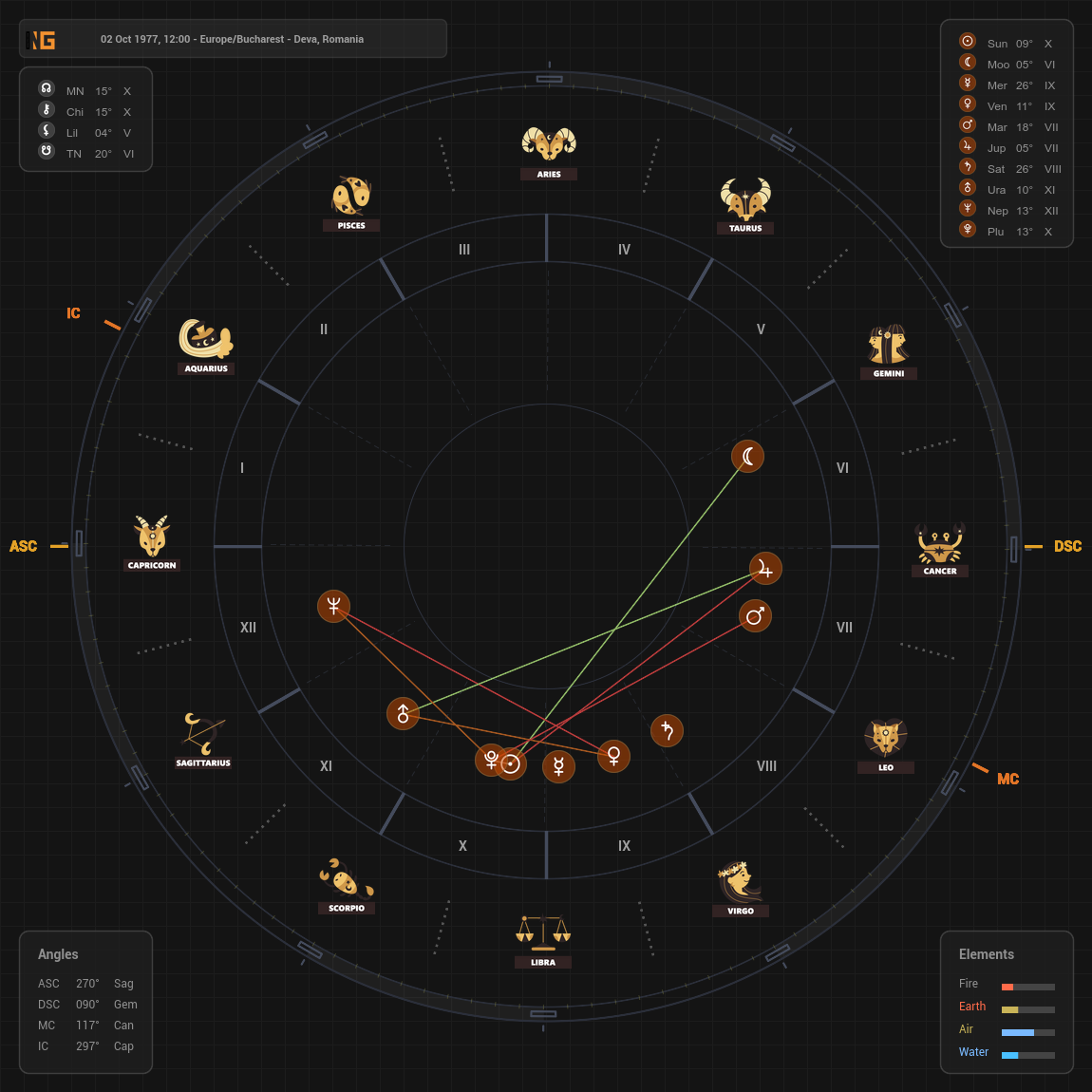
- Sun: ♎︎ Libra
- Moon: ♊︎ Gemini
- Mercury: ♍︎ Virgo
- Venus: ♍︎ Virgo
- Mars: ♋︎ Cancer
- Jupiter: ♋︎ Cancer
- Saturn: ♌︎ Leo
- Uranus: ♏︎ Scorpio
- Neptune: ♐︎ Sagittarius
- Pluto: ♎︎ Libra
- Mean Node: ♎︎ Libra
- True Node: ♊︎ Gemini
- Chiron: ♎︎ Libra
- Lilith: ♉︎ Taurus
- Sun: House 10
- Moon: House 6
- Mercury: House 9
- Venus: House 9
- Mars: House 7
- Jupiter: House 7
- Saturn: House 8
- Uranus: House 11
- Neptune: House 12
- Pluto: House 10
- Mean Node: House 10
- True Node: House 6
- Chiron: House 10
- Lilith: House 5
- fire: 2
- earth: 2
- air: 3
- water: 3
- cardinal: 4
- fixed: 2
- mutable: 4
- Build a “clarity ritual” for relationships and money: written agreements, transparent budgets, and slow pacing when emotions are high (Venus square Neptune, Saturn 8th).
- Use your 10th-house Libra power intentionally: choose roles where ethics, mediation, design, justice, or healing leadership are central—visibility is part of your medicine (Sun/Pluto/Node/Chiron in 10th).
- Support your Moon-in-6th nervous system with steady daily anchors: sleep, hydration, movement, and information boundaries; your emotional life improves when your routine is kind.
- Practice clean conflict: direct requests, time-outs, and repair conversations (Mars in Cancer square Pluto/Chiron) so intensity becomes intimacy rather than struggle.
- Create protected solitude for spiritual hygiene (Neptune 12th): dream journaling, meditation, nature walks, or quiet study—your intuition strengthens when you decompress.
- Avoid romantic or financial fog: if it isn’t clear, it isn’t ready—especially in love, contracts, or shared money (Venus square Neptune, Saturn 8th).
- Watch the swing between people-pleasing and control: resentment grows when you stay polite past your limit (Libra/Pluto emphasis; Mars–Pluto tension).
- Don’t overextend to prove generosity or success; measure growth with realism, not hope alone (Sun square Jupiter).
- Be mindful of emotional reactivity in partnership—protectiveness can become defensiveness if needs aren’t named early (Mars/Jupiter in Cancer 7th).
The Astral Interpretation
Based on your natal chart
Zodiac & Ascendant
Zodiac Sign
Libra
Ascendant
Sagittarius
Planets in Signs
Planets in Houses
Elements Distribution
Modalities Distribution
Major Aspects
☉ Sun trine ☽ Moon
A natural inner cooperation: what you feel and what you intend can be brought into harmony. You tend to recover quickly after emotional weather, and your presence often feels coherent to others—like you mean what you say, even when you’re still figuring it out.
☉ Sun square ♃ Jupiter
Big-hearted expectations meet real-world limits. This aspect can swing between over-promising and under-celebrating; the lesson is calibrated confidence—learning when to grow, when to refine, and when “enough” is actually success.
☉ Sun conjunct ♇ Pluto
A life-force with depth, magnetism, and a refusal to live superficially. You are built for reinvention. Authority, power dynamics, and the courage to name what others avoid become defining themes—especially in public or professional life.
☉ Sun conjunct ⚷ Chiron
Your identity carries a tender seam: the feeling of not being fully seen, or of needing to earn belonging. Over time, that sensitivity becomes medicine—your leadership grows more human, more healing, more brave.
☉ Sun conjunct ☊ Mean Node
Purpose and identity are braided together. When you choose the path of integrity (not performance), doors open. Your calling tends to arrive through visible roles, reputation shifts, or moments when you are asked to stand for something.
♀ Venus sextile ♅ Uranus
You love with fresh air in the room. Attraction can be sparked by originality, intelligence, and difference. This is a signature for unusual tastes, liberating friendships, and relationships that thrive on growth rather than control.
♀ Venus square ♆ Neptune
A romantic imagination that can turn longing into a mirage. This aspect asks for compassionate discernment: keep the poetry, but verify the facts—especially around money, desire, and who you are trying to save.
♂ Mars square ♇ Pluto
Intense willpower and high emotional voltage. Power struggles can appear when anger is swallowed instead of spoken cleanly. When integrated, this is formidable courage—an engine for transformation, protection, and decisive change.
♂ Mars square ⚷ Chiron
Asserting yourself can touch an old bruise: fear of conflict, fear of being “too much,” or fear of rejection when you want what you want. Healing comes through practicing directness with tenderness—firm, not cruel.
♃ Jupiter trine ♅ Uranus
Fortune favors your willingness to evolve. Sudden openings, inspired risks, and brilliant timing arrive when you trust your instincts and stay flexible. You learn fast from life, and life rewards your curiosity.
♆ Neptune sextile ♇ Pluto
A generational signature of spiritual and psychological depth: the urge to dissolve old patterns and remake meaning. You sense undercurrents—what is dying, what is being born—and this intuition quietly guides you.
♇ Pluto conjunct ☊ Mean Node
Fated intensity around vocation and visibility. Encounters with power—your own and others’—shape your trajectory. You are meant to outgrow fear of your impact, and to use influence ethically.
☊ Mean Node conjunct ⚷ Chiron
Your path is inseparable from healing themes. The very area that once felt like a flaw becomes a compass. You are pulled toward roles where your lived wisdom can create fairness, dignity, and repair.
Astral Summary
You arrive in the world with Sagittarius rising—an open horizon in your eyes—yet your Sun in Libra is not content with mere freedom; it wants meaning, balance, and a life that feels beautifully aligned. The chart is shaped like a bucket: much of your energy gathers in the relational and public realms, and one part of you becomes the handle—the place where you carry the whole story. That handle is your powerful 10th-house cluster in Libra: Sun, Pluto, Chiron, and the Node, like a bright crest on a mountain ridge. You are built to be seen, but not in a shallow way; you are built to be changed by what you do in the world, and to change the world in return.
Air and Water are nearly equal, so your mind and your feelings are constant companions—sometimes collaborators, sometimes rivals. Cardinal and Mutable emphasis makes you a starter and an adapter: you initiate, then you refine. With harmony outweighing tension, life often offers you bridges—yet the square edges (especially around desire, power, and hope) are what carve your strength. Beneath it all, there is a quiet spiritual undertow (Neptune in the 12th): an unseen sensitivity that needs solitude, truth, and clean boundaries to stay luminous.
Personality
Technical Interpretation
Libra Sun in the 10th house gives a public-facing identity shaped by fairness, aesthetics, diplomacy, and ethical responsibility. Sagittarius Ascendant adds candor, optimism, and a questing temperament—often experienced by others as straightforward, humorous, and future-oriented. With strong Pluto dominance (Pluto 7, Sun 9) and Sun conjunct Pluto, your personality has intensity and x-ray perception: you tend to notice motives, subtext, and structural imbalances. Mercury in Virgo (9th) adds precision and discernment; you think in systems, edit quickly, and prefer evidence over hype. Western hemisphere emphasis (analysis: western 12) shows that people—partners, clients, audiences—are catalysts; your identity evolves through relationship mirrors and social feedback.
Oracle Interpretation
You’re the kind of person who can stand in a bright room and still feel the secret currents running underneath. There is grace in how you move through the world—an instinct to make things fair, to make them make sense—but behind the grace lives a fierce truth-teller who refuses to live a borrowed life. You were never meant to be small. You were meant to become honest, and then become influential—not by force, but by integrity that radiates. Even when you’re quiet, you have presence: the feeling that something in you is awake, watching, learning, becoming.
Emotional Profile
Technical Interpretation
Moon in Gemini in the 6th house suggests emotions that process through thought, language, and daily rhythm. Your nervous system is sensitive to clutter—mental, social, and environmental—so emotional wellbeing improves with routines, sleep regularity, and meaningful work. Sun trine Moon supports emotional integration and resilience; you can often articulate what you feel and translate it into action. True Node in Gemini in the 6th reinforces the life lesson of learning, listening, and staying curious in everyday life—rather than seeking certainty through distant ideals. Neptune in the 12th can heighten empathic permeability: you may absorb atmospheres, moods, and unspoken grief, requiring conscious energetic boundaries.
Oracle Interpretation
Your feelings don’t arrive as one big wave—they arrive like many small birds, each carrying a message. Some days your heart speaks in sentences, not sobs. And when life becomes too loud, your spirit asks for simple medicine: clean mornings, a task you can complete, a walk where your thoughts can loosen their grip. You are not “too mental”—you are a translator of emotion into understanding. But you must remember: even translators need rest. Let silence be a home you visit often.
Relationships
Technical Interpretation
Mars and Jupiter in Cancer in the 7th house emphasize partnership as a major arena of growth. You attract (and become) protectors: relationships are emotionally significant, loyalty-driven, and often family-oriented. Jupiter in the 7th can bring beneficial alliances, but Sun square Jupiter warns against idealizing partners or making relational promises bigger than reality. Mars square Pluto indicates intensity and potential power struggles; conflict styles matter—passive aggression or control dynamics must be consciously avoided. Venus in Virgo (9th) describes love expressed through practicality, devotion, and improvement; you’re drawn to intelligent, capable people, often from different backgrounds or through travel/learning. Venus square Neptune increases the risk of confusion, savior fantasies, or blurred boundaries—clarity and pacing are essential.
Oracle Interpretation
Love, for you, is not a hobby—it is a threshold. You want tenderness that feels like home, but you also want honesty that doesn’t flinch. When you fall, you can pour devotion into the cracks of another person’s life, hoping your care will become proof. Yet your soul keeps learning a quieter truth: love is not measured by how much you endure. It’s measured by how free you can breathe beside someone. The right bond won’t ask you to abandon your instincts; it will ask you to trust them.
Compatibility
Technical Interpretation
Strong Air signatures (Libra Sun, Gemini Moon) typically harmonize with Air and Fire-heavy charts (Gemini/Libra/Aquarius; Aries/Leo/Sagittarius) that support communication, movement, and shared curiosity. However, with Mars and Jupiter in Cancer plus Neptune in the 12th, you also need emotional maturity and safety—partners with grounding Earth placements (Virgo/Taurus/Capricorn) can stabilize daily life and help clarify values. Watch for partners whose Neptune or Pisces emphasis amplifies Venus square Neptune themes (idealization, vagueness). Best compatibility tends to come from people who combine warmth with accountability, and who respect your need for both intimacy (Cancer) and space (Sagittarius rising).
Oracle Interpretation
You match best with people who can talk to you like a friend and hold you like a home. Someone who keeps their promises softly—without theatrics—will feel like rain on dry ground. Your heart thrives with a partner who loves learning, who doesn’t fear change, and who tells the truth kindly. The wrong match is always the same story: beautiful words, blurry actions. Your soul is learning to fall in love with consistency.
Career
Technical Interpretation
A 10th-house concentration (Sun, Pluto, Chiron, Mean Node) makes vocation central. Libra in the 10th points to careers involving mediation, law/justice, design/aesthetics, diplomacy, public relations, counseling, or any role where balance and ethical judgment are required. Sun conjunct Pluto adds leadership in high-stakes environments, crisis management, transformation work, or positions of influence; you may be drawn to reforming systems. Mercury and Venus in Virgo in the 9th support teaching, writing, analysis, health/wellness education, editing, languages, research, and international or academic pathways. Uranus in Scorpio in the 11th favors innovative networks, strategic alliances, and working with groups, technology, or social change movements.
Oracle Interpretation
You’re not here to merely earn a living—you’re here to make something right. Your work wants to matter, to leave a signature of fairness behind you. Life will keep placing you near turning points—institutions, families, teams—where the old way no longer works. And there you are: the one who can see the pattern, name the truth, and rebuild with grace. Your calling is a kind of artistry: taking what is messy and making it workable, humane, and real.
Money
Technical Interpretation
With strong 7th/10th house emphasis, finances can be closely tied to partnerships, contracts, and public reputation. Jupiter in the 7th can bring financial opportunity through clients or allies, but Sun square Jupiter cautions against overextending, inflated projections, or generous spending to maintain an image of success. Venus in Virgo suggests careful budgeting and preference for practical value; you’re often good at improving systems and reducing waste. Venus square Neptune warns to keep finances transparent in relationships and to avoid unclear deals, vague pricing, or “trust me” arrangements. Saturn in the 8th favors slow, disciplined management of shared resources, debts, taxes, inheritances, and long-term investments—wealth builds through structure, not shortcuts.
Oracle Interpretation
Money, for you, is meant to become calmer with time. Early on it can feel like tides—rising with opportunity, falling with generosity, blurring when emotions get involved. Your medicine is clarity: name the number, name the boundary, name the agreement. When you do, prosperity stops being a gamble and starts being a garden. You don’t need luck as much as you need clean promises—especially with shared resources.
Shadow Work
Technical Interpretation
Sun conjunct Pluto and Mars square Pluto indicate shadow themes around control, fear of vulnerability, and power dynamics—especially in visible roles and intimate/partnered contexts (10th/7th axis). Venus square Neptune points to projection: seeing what you hope for rather than what is present, particularly in love or value judgments. Saturn in the 8th can manifest as guardedness around trust, intimacy, and dependency; there may be fear of owing or being owed. Neptune in the 12th can bring escapist coping (over-idealizing, disappearing, spiritual bypassing) if emotions are not processed directly. The growth path is to practice direct communication (Gemini Moon/Node) and healthy confrontation without domination (Mars-Pluto).
Oracle Interpretation
Your shadow doesn’t look like cruelty—it looks like over-responsibility, over-reading, over-holding. It looks like trying to manage life so you won’t be surprised by loss. Sometimes you grip the wheel because you once learned that chaos could arrive unannounced. But healing is not the same as control. Healing is letting truth be spoken early—before it becomes a storm. Your soul softens when you stop negotiating with red flags and start negotiating with your own worth.
Spirituality
Technical Interpretation
Neptune in Sagittarius in the 12th house is a strong signature for private spirituality, vivid dreams, ancestral/mystical sensitivity, and intuitive guidance that comes through solitude. It supports meditation, retreat, prayer, compassionate service, and study of philosophy or sacred traditions. Neptune’s supportive sextiles to Pluto/Node/Chiron suggest that spiritual practices can directly empower your life purpose and healing vocation—your intuition becomes more reliable when grounded by ethical intention and real-world application. Moon in the 6th also spiritualizes daily routine: ritual in ordinary life (walking, journaling, breathwork, devotion to craft) is especially effective.
Oracle Interpretation
You don’t need a loud religion—you need a quiet doorway. Your spirit speaks in symbols, in timing, in dreams that feel like letters from a deeper self. When you honor solitude, you become clearer; when you ignore it, you become porous. Your faith is meant to be lived, not performed: a candle lit in the private room of your life, a promise to tell the truth, a vow to keep your heart clean.
Life Path
Technical Interpretation
Mean Node in Libra in the 10th, tightly conjunct Chiron and close to Pluto and the Sun, emphasizes a destiny around visible contribution: learning balanced leadership, ethical authority, and relational intelligence in public life. The North Node (True Node) in Gemini in the 6th (as given) highlights an additional developmental thread: mastering communication, adaptability, and skill-building through daily work and service. The chart’s bucket shape suggests a focused life mission: energy concentrates around career/relationship/service themes rather than spreading evenly. Western hemisphere emphasis indicates that key turns often arrive through other people—mentors, partners, rivals, clients—who act as mirrors guiding you toward your rightful role.
Oracle Interpretation
Your path is not about being perfect—it’s about being useful in the most beautiful way. Life keeps asking you to become a fair-minded leader with a healing touch: someone who can hold conflict without becoming it. You are learning that service is not self-erasure; it is craft, devotion, skill, and presence. The road opens when you stop trying to be liked by everyone and start trying to be true—because your truth is the very thing that makes you trustworthy.
Timing
Technical Interpretation
Key life cycles to watch: Jupiter returns roughly every 12 years (ages ~12, 24, 36, 48, 60), often bringing partnership growth and opportunity because Jupiter sits in the 7th. Saturn returns around age 29–30 (and again ~58–59); with Saturn in the 8th, these periods emphasize restructuring shared finances, intimacy, psychological commitments, and long-term security. Nodal returns occur about every 18.6 years (~18–19, ~37–38, ~56–57), often coinciding with vocational redirection and a renewed call toward balanced leadership/service. Midlife transits tend to awaken the Uranus-in-11th theme: shifts in friendships, communities, and long-range goals; the need for authentic networks becomes non-negotiable.
Oracle Interpretation
Your life moves in chapters marked by doors that only open when you’re ready to tell the truth. Around 18–19, you likely felt the first strong pull toward your own direction—an urge to choose your voice. Around 29–30, life pressed on the foundations: trust, money, intimacy, and the ways you bind yourself to others. Around 37–38, another turning arrived: a call to recalibrate your work and your purpose, to live less for approval and more for alignment. The years ahead favor a softer power—choosing communities that nourish you, and building a legacy that feels clean in your conscience.
Character Profile
Technical Interpretation
Your character blends Libra’s ethical awareness and relational intelligence with Sagittarius rising’s candor and forward motion. Sun conjunct Pluto adds intensity, courage, and psychological depth; you often prefer real conversations over polite ones, even if you deliver truth gracefully. Moon in Gemini makes you mentally agile and socially perceptive; you can compartmentalize in order to function, and you’re rarely without an internal narrative. Mercury/Venus in Virgo gives humility and craft: you notice details, improve processes, and express care through competence. Cardinal and Mutable dominance (analysis: 4/4) indicates a temperament that initiates and adapts, though the lower Fixed emphasis can make long-term consistency a learned skill rather than an automatic one. The shadow expression is people-pleasing (Libra) alternating with intensity/control (Pluto), especially when stakes feel high.
Oracle Interpretation
At your best, you are a steady lantern: intelligent, attentive, fair—someone who makes people feel both challenged and safe. You can read a room the way others read a book, and you often sense the unspoken line that needs to be said aloud. You’re not made for shallow living. Even your kindness has backbone. When you doubt yourself, it’s usually because you’re trying to be agreeable instead of being honest. But your true nature is simple: you’re here to bring clarity with compassion, and to turn life’s mess into something wise.
Life Story
Technical Interpretation
The chart’s bucket shape and strong 10th-house focus indicate a life oriented around a central mission, with career/public identity acting as the primary outlet for the chart’s energy. Sun in Libra in the 10th conjunct Pluto and close to the Mean Node and Chiron describes recurring “destiny moments” where vocation, visibility, and leadership intertwine with deep transformation and healing themes. The first Saturn square (~7), opposition (~14–15), and return (~29–30) are especially meaningful because Saturn is in the 8th house: early lessons about trust, scarcity, emotional control, or shared resources may have shaped a guarded maturity. Jupiter’s 12-year cycles are amplified by Jupiter in the 7th: major growth spurts arrive through partnerships, clients, and alliances (ages ~24, 36, 48). Nodal cycles (~18–19, ~37–38) activate the 10th/6th axis themes: purpose, work, service, and public contribution.
Moon in Gemini in the 6th suggests a childhood/adolescence pattern of adapting through busyness, learning, and caretaking in daily life; emotional safety may have been linked to being useful, competent, or “fine.” Neptune in the 12th adds sensitivity to atmospheres and unspoken family narratives, while Venus square Neptune suggests formative experiences of idealization/disappointment in love or value—learning to separate longing from reality. Mars in Cancer in the 7th square Pluto/Chiron/Node indicates pivotal relationship chapters where conflict, protection, and boundaries become catalysts for growth; these likely coincide with major career shifts or changes in public identity (10th/7th tension). Over time, the Sun–Moon trine supports integration: you learn to make your emotional intelligence an asset rather than a complication, and your leadership becomes more compassionate and psychologically literate.
Oracle Interpretation
You were born with a bright public star and a private ocean.
As a child, you likely learned early that paying attention mattered—that moods had weather, that words could change a room, that being clever and helpful could smooth the edges of adult tension. Around the age of 7, life may have asked you to grow up a little faster than you wanted: to understand trust, loyalty, and what it costs to lean on someone. You became observant. You became capable. And somewhere inside, you made a vow to stay composed.
Around 10, your mind began to run ahead of your years. You started noticing the difference between what people said and what they meant. You learned the art of adjusting—fitting yourself into the day, reading the rules, becoming useful. But sensitivity was always there, like a secret sense. You could feel the unsaid.
At 14–15, a more electric restlessness arrived. You weren’t satisfied with simple answers anymore. You began to understand power—who had it, who wanted it, who pretended not to. Part of you wanted to keep the peace; another part wanted to tell the whole truth. This tension became one of your lifelong teachers.
In your early twenties, the world widened. You were pulled toward learning, travel, or ideas that sharpened your standards. Love, too, carried lessons: the beautiful dream versus the real person. You may have discovered that your devotion can be so pure it becomes dangerous—because it tempts you to forgive what you shouldn’t, or to hope so loudly you stop hearing reality. Still, your heart stayed brave.
Around 29–30, the great restructuring: the years when life asks, “What are you building—and what is it built on?” Trust, shared resources, intimacy, and fear of losing control came to the surface. Something in you had to harden in the right way: not into coldness, but into boundaries. This was the moment you stopped confusing endurance with love, and obligation with destiny.
After 30, your power became cleaner. You began to understand that you are not here merely to be liked—you are here to be respected by your own soul. Around 37–38, another pivot called you forward: a new alignment with purpose, a shift in work, or a deeper decision to live by values rather than applause. You started to choose relationships and communities that didn’t drain you. You started to see how your sensitivity is not weakness—it is radar.
And now, your life continues like a lantern carried up a mountain path: each step makes you more yourself. You are becoming the kind of leader who heals by example—someone who can hold complexity, speak honestly, and still keep their heart open. Not perfect. Not finished. But unmistakably real.
Recommendations
Warnings
Chart Set - 603ae62b620a...
Includes astral chart, and smart analysis.
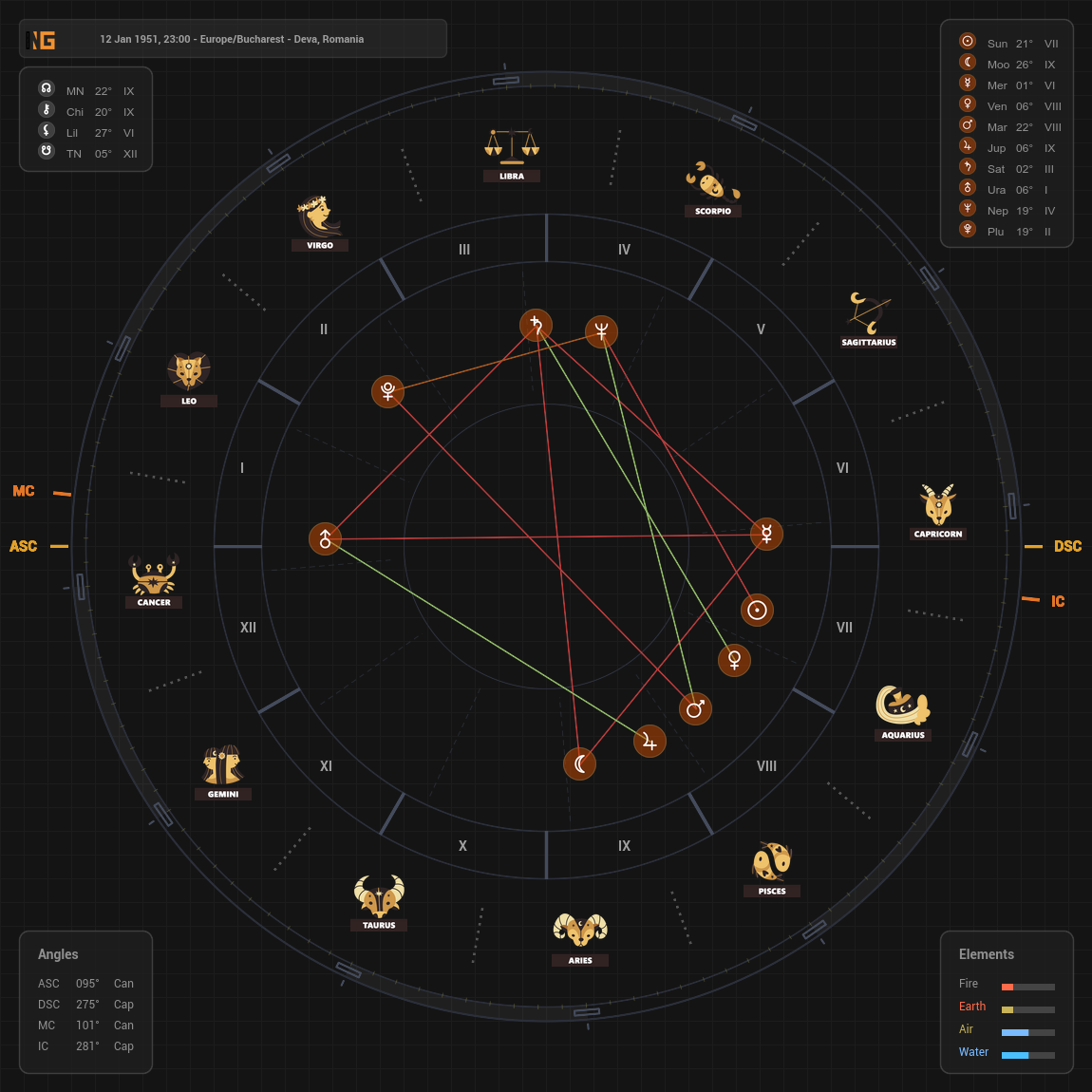
- Sun: ♑︎ Capricorn
- Moon: ♓︎ Pisces
- Mercury: ♑︎ Capricorn
- Venus: ♒︎ Aquarius
- Mars: ♒︎ Aquarius
- Jupiter: ♓︎ Pisces
- Saturn: ♎︎ Libra (retrograde)
- Uranus: ♋︎ Cancer (retrograde)
- Neptune: ♎︎ Libra
- Pluto: ♌︎ Leo (retrograde)
- Mean Node: ♓︎ Pisces (retrograde)
- True Node: ♊︎ Gemini
- Chiron: ♓︎ Pisces
- Lilith: ♐︎ Sagittarius
- Sun: House 7
- Moon: House 9
- Mercury: House 6
- Venus: House 8
- Mars: House 8
- Jupiter: House 9
- Saturn: House 3
- Uranus: House 1
- Neptune: House 4
- Pluto: House 2
- Mean Node: House 9
- True Node: House 12
- Chiron: House 9
- Lilith: House 6
- fire: 1 (low) — fire is precious here: confidence and spontaneity are cultivated rather than automatic.
- earth: 2 (moderate-low) — practicality exists, but it’s not the whole story; you build best when meaning is present.
- air: 4 (high) — the mind is active: analysis, perspective, ethics, and dialogue shape your choices.
- water: 3 (high) — strong emotional tides: empathy, memory, intuition, and spiritual sensing.
- cardinal: 5 (high) — an initiator’s signature: you start chapters, steer situations, and set plans in motion.
- fixed: 3 (moderate) — loyalty and staying power once you decide what matters.
- mutable: 2 (lower) — adaptability is learned through life; you prefer direction over drift.
- Practice “compassion with structure”: make your kindness measurable (clear time limits, clear agreements, clear boundaries).
- Give your mind both discipline and freedom: one steady daily routine (Mercury in 6th) plus a regular outlet for originality (Mercury–Uranus).
- Choose relationships where truth is spoken early—especially about money, expectations, and emotional labor (8th-house emphasis).
- Nourish the 9th-house soul: read, teach, travel when possible, study a philosophy or spiritual path that supports discernment as much as faith.
- Work with the body to release intensity (Mars–Pluto): somatic therapy, breathwork, swimming, long walks, or gentle strength training.
- Keep a dream/journal practice (Pisces/12th themes): your unconscious is one of your most reliable guides when you record it.
- Beware of idealizing partners or family dynamics and then feeling betrayed by reality (Sun square Neptune). Clarity is an act of love.
- Watch the tendency to self-silence or over-edit your truth out of fear of being wrong or judged (Mercury square Saturn).
- Avoid power struggles disguised as ‘help’ or ‘protection’—especially around shared resources, intimacy, or loyalty tests (Mars opposite Pluto; 8th-house emphasis).
- Be cautious with emotional over-responsibility: you are allowed to need support, not only provide it (Moon opposite Saturn).
The Astral Interpretation
Based on your natal chart
Zodiac & Ascendant
Zodiac Sign
Capricorn
Ascendant
Cancer
Planets in Signs
Planets in Houses
Elements Distribution
Modalities Distribution
Major Aspects
☉ Sun square ♆ Neptune
A lifelong theme of clarifying identity through fog: idealism, sacrifice, spiritual longing, and occasional disillusionment. The medicine is discernment—learning where compassion ends and self-erasure begins.
☉ Sun sextile ☊ Mean Node
When you live with purpose, doors open. Your core self naturally supports your karmic direction—especially through teaching, mentoring, travel, or meaning-making.
☉ Sun sextile ⚷ Chiron
Your presence can be quietly healing. Wounds become wisdom when you allow your story to be useful rather than hidden.
☽ Moon opposition ♄ Saturn
Tender feelings meeting a stern inner judge. Early responsibility, emotional restraint, or a sense of having to ‘hold it together’ can mature into deep reliability and calm emotional authority.
☽ Moon square ☿ Mercury
Mind and heart don’t always speak the same language. You may process feelings intellectually, or feel misunderstood; integrating emotion into words becomes a key skill.
☽ Moon conjunct ☊ Mean Node
Your emotional life is not incidental—it is directional. Encounters, travels, studies, and spiritual seasons shape your destiny through feeling, intuition, and compassion.
☽ Moon conjunct ⚷ Chiron
A tender empathic signature: you sense what others hide. The lesson is to heal without absorbing—turning sensitivity into a gift with boundaries.
☽ Moon square ⚸ Lilith
Instincts can clash with social expectations. There’s a wild, honest truth in you that refuses to be domesticated—especially around faith, freedom, or speaking the taboo.
☿ Mercury square ♄ Saturn
A serious mind shaped by discipline and doubt. You may have learned to measure your words; mastery comes through patience, study, and trusting your mental authority.
☿ Mercury opposition ♅ Uranus
A lightning intellect: original, contrarian, intuitive. Restlessness and nervous tension are possible—your mind needs both stimulation and quiet.
☿ Mercury conjunct ⚸ Lilith
A voice that can cut through pretense. You speak what others avoid; your truth-telling is powerful when guided by care, not only intensity.
♀ Venus trine ♄ Saturn
Love that endures. You value loyalty, maturity, and acts of responsibility; affection deepens through time, shared effort, and trust.
♀ Venus trine ☊ True Node
Relationships and aesthetics are part of your path. Encounters can feel ‘fated’—not to trap you, but to teach you how to choose with grace.
♂ Mars trine ♆ Neptune
Action guided by intuition. You’re strongest when pursuing a vision—creative, charitable, spiritual, or socially meaningful goals.
♂ Mars opposition ♇ Pluto
Immense will and intensity. Power dynamics can surface in conflict or desire; the lesson is to transform force into courage, strategy, and conscious passion.
♃ Jupiter trine ♅ Uranus
Sudden luck through bold ideas: travel, study, innovation, or unconventional opportunities. Your growth accelerates when you dare to be different.
♃ Jupiter square ☊ True Node
Big beliefs can pull you off-course if they become too absolute. Your destiny asks for curiosity, listening, and flexible learning rather than one final ‘truth.’
♄ Saturn square ♅ Uranus
The classic tension between stability and freedom. Life teaches you to redesign structures instead of simply breaking them—or obeying them.
♄ Saturn trine ☊ True Node
Steady effort aligns with your long-term purpose. Discipline, craft, and accountability become bridges toward fate—not burdens.
♆ Neptune sextile ♇ Pluto
A generational signature of deep spiritual and cultural transformation—an ability to sense the undercurrents and evolve through them.
☊ Mean Node conjunct ⚷ Chiron
Your path is inseparable from healing themes: faith, meaning, forgiveness, and compassionate perspective. You learn—and teach—through what once ached.
Astral Summary
You enter the world as Cancer rising—softly armored, watchful, and profoundly responsive to atmosphere—yet at your core the Sun in Capricorn steadies you like a mountain that learned to love. This is a life built from contrasts: a practical will that wants results, and a Pisces Moon that wants mercy, music, and meaning. Air and water dominate, so you live with a mind that won’t stop asking questions and a heart that won’t stop sensing what’s unspoken. Your chart moves like a locomotive: once you gather momentum, you pull whole seasons behind you—work, family, commitments, promises—because you are made to carry something important forward. There is strong emphasis on the 9th house, suggesting a soul that grows through study, travel, philosophy, and spiritual curiosity; life keeps widening your horizon until it matches your compassion. Venus and Neptune are powerful in you: love, ideals, and imagination are not decorations—they are engines. Yet tension aspects remind you to separate truth from longing, and duty from emotional self-denial. Your story is about becoming both discerning and tender: a wise heart with boundaries, and a responsible life with soul.
Personality
Technical Interpretation
Capricorn Sun in the 7th house gives you a relational identity: you define yourself through partnership, commitments, and the mirror of significant others. Cancer Ascendant adds sensitivity, protectiveness, and a strong instinct for emotional safety. With high cardinal emphasis, you’re proactive—someone who initiates solutions and takes responsibility. Dominance highlights Venus and Neptune strongly, so charm, values, artistry, and idealism are central motivators; Mars also has strength, adding resolve and principled intensity. The locomotive chart shape suggests a driven personality that gains speed over time and prefers purposeful direction rather than scattered living.
Oracle Interpretation
You don’t simply “have a personality”—you have a climate. People feel it when they step into your presence: the quiet watchfulness, the careful kindness, the sense that you’ve lived enough to know what matters. You were born with the gift of seriousness that is not cold, but consecrated—like you promised your life to something meaningful. And still, behind your steady gaze, there is water: tenderness, nostalgia, a private softness you only show where it is safe. You’re the kind of person who can hold a room together without raising your voice. When you want something, you don’t chase it loudly—you build the road to it.
Emotional Profile
Technical Interpretation
Moon in Pisces in the 9th house describes an empathetic, impressionable emotional nature that seeks faith, meaning, and moral coherence. Moon conjunct Mean Node and Chiron intensifies sensitivity and suggests emotional experiences are pivotal to your growth—especially through learning, travel, spiritual practice, or mentoring. Moon opposition Saturn can indicate early emotional restraint, responsibility, or distance with caretakers, and a tendency to self-contain feelings. Moon square Mercury adds inner conflict between thinking and feeling; naming emotions clearly becomes a life skill.
Oracle Interpretation
Your emotions don’t move in straight lines—they move in tides. Sometimes you feel like you’re living in two worlds: the visible one where you do what must be done, and the invisible one where you carry everyone’s sorrows, hopes, and unspoken prayers. You learned early that feelings can be heavy, that love can ask you to be brave—and so you became capable. But your heart is not meant to be locked in a vault. It is meant to be translated into meaning: into wisdom, into forgiveness, into a larger view that turns pain into gentleness. When you let yourself cry without explaining it, something in you heals.
Relationships
Technical Interpretation
Sun in the 7th house makes partnership central: you’re oriented toward commitment, fairness, and building a life with another. Venus in Aquarius in the 8th house seeks honesty, freedom, and psychological depth; intimacy must include friendship, respect, and truth. Venus trine Saturn supports loyalty and long-term devotion, often preferring mature or stable bonds. Mars in Aquarius in the 8th adds strong desires for authenticity and can attract intense transformational relationships; Mars opposition Pluto warns against power struggles or all-or-nothing dynamics. Sun square Neptune can bring idealization in love—learning to see partners clearly is key.
Oracle Interpretation
Love for you is not a pastime—it is an initiation. You don’t want surface romance; you want the kind of bond that changes your chemistry, the kind that makes you more honest with yourself. You need a partner who respects your sensitivity without trying to own it, and who meets your loyalty with loyalty. At your best, you love like a lighthouse: steady, guiding, protective. At your hardest, you can love like a dream—so beautiful you forget to ask whether it’s real. Your heart’s lesson is simple and profound: choose what is true, not only what is enchanting.
Compatibility
Technical Interpretation
You tend to resonate with partners who honor emotional safety (Cancer rising) and share practical commitment (Capricorn Sun). Water signs (Cancer/Scorpio/Pisces) can meet your sensitivity, while earth signs (Taurus/Virgo/Capricorn) support your need for reliability. Aquarius emphasis (Venus/Mars) also needs intellectual friendship and personal freedom—air signs (Aquarius/Gemini/Libra) can fit well if emotional depth is not dismissed. Because of Sun square Neptune and Mars opposition Pluto, you do best with partners who communicate clearly, avoid manipulation, and respect boundaries around caretaking and sacrifice.
Oracle Interpretation
Your best matches feel like calm strength: someone whose presence steadies your waters, not someone who stirs them for sport. You thrive with a love that is both warm and spacious—devotion without possession. You’re drawn to unusual minds and honest hearts, to people who have survived something and became kinder, not harder. When love is right, it doesn’t make you smaller; it makes you clearer. It feels like breathing more fully.
Career
Technical Interpretation
With a strong 9th-house emphasis (Moon, Jupiter, Mean Node, Chiron), vocations involving teaching, mentoring, writing, languages, travel, religion/spirituality, law/ethics, or cross-cultural work are highlighted. Mercury in Capricorn in the 6th supports disciplined work habits, planning, administration, and competence in service roles; however, Mercury square Saturn can bring self-criticism or pressure, while Mercury opposition Uranus favors innovative thinking and problem-solving. Neptune in the 4th can indicate working from home, fluid family responsibilities, or a need for an inspired environment. The locomotive shape suggests sustained achievement through focused direction.
Oracle Interpretation
Your work wants to matter. You are not built for empty striving—you’re built for usefulness, for guiding, for translating experience into something that helps others live. When you are aligned, your career becomes a road of meaning: each job a chapter, each skill a tool you can offer. You do well where wisdom is needed, where people need calm counsel, where ideas must be made practical. You are at your most powerful when your daily life feels like a quiet vow kept.
Money
Technical Interpretation
Pluto in the 2nd house suggests deep transformations around resources, self-worth, and financial control—periods of intensity followed by renewal. Venus and Mars in the 8th house emphasize shared finances, inheritances, taxes, partner resources, and psychological ties to money; this can bring benefits through alliances but also necessitates clear agreements. Mars opposition Pluto warns against financial power struggles or risk driven by intensity. Venus trine Saturn supports cautious, long-term financial planning and building security through steady effort.
Oracle Interpretation
Money is never just money in your life—it is safety, power, trust, and sometimes a battlefield where old fears try to return. Yet you are meant to become wiser than those fears. Each time life asks you to renegotiate resources, it is also asking you to renegotiate self-worth. You thrive when finances are handled like sacred agreements: clear, fair, and spoken aloud. Prosperity comes when you choose long-term steadiness over emotional urgency—and when you remember you are not here to be owned by what you own.
Shadow Work
Technical Interpretation
Moon opposition Saturn and Mercury square Saturn point to an inner critic, emotional withholding, or the habit of earning love through usefulness. Sun square Neptune can produce confusion about identity, savior tendencies, or disappointment when ideals meet reality. Mars opposition Pluto suggests shadow themes around control, anger, and intensity—learning to use power consciously rather than reactively. Lilith contacts (Moon square Lilith; Mercury conjunct Lilith) indicate taboo truth-telling and a need to integrate instinct without self-sabotage.
Oracle Interpretation
Your shadow is not darkness—it is the part of you that learned to survive. It can look like silence when you are hurt, like over-responsibility when you are lonely, like giving more than you can afford because you want peace. It can look like wanting control when life feels uncertain. But the deeper truth is tender: you simply wanted to be safe, and you learned safety through strength. Your healing begins when you allow yourself to need things without shame—rest, reassurance, honesty, softness. The moment you stop proving your worth, your life becomes lighter.
Spirituality
Technical Interpretation
Pisces Moon and Jupiter in the 9th house indicate a natural spiritual orientation, compassion, and faith in the unseen. Mean Node conjunct Moon/Chiron further ties your growth to spiritual learning, pilgrimage-like phases, and healing through belief systems. Sun square Neptune intensifies mysticism and imagination, but requires discernment to avoid escapism or idealization. True Node in Gemini in the 12th suggests spiritual development through quiet study, prayer/meditation, dreamwork, and learning to listen to subtle signals.
Oracle Interpretation
You are a believer—even when you doubt. Your spirit listens for meaning the way others listen for news. Sometimes you find God in a book, sometimes in a landscape, sometimes in a single merciful sentence spoken at the right time. Your intuition is an instrument; it needs tuning, silence, and trust. When you make room for solitude, your inner world becomes luminous—dreams become messages, coincidences become guidance, and your compassion becomes not a burden, but a blessing with boundaries.
Life Path
Technical Interpretation
The chart’s emphasis on cadent houses (analysis shows strong cadent power) and the 9th/12th axis suggests a life path focused on learning, inner development, and perspective rather than public spectacle. True Node in Gemini in the 12th points toward cultivating quiet curiosity, flexible thinking, and spiritual/psychological insight—moving away from rigid certainty and toward listening, writing, study, and compassionate service behind the scenes. Sun in the 7th indicates that key life chapters unfold through partnership and alliances.
Oracle Interpretation
Your path is not a straight highway—it is a pilgrim road. You are here to become someone who understands: not just facts, but hearts. Life keeps guiding you toward softer truths: listening instead of declaring, curiosity instead of certainty, peace instead of being right. You are meant to be the person who notices what others miss, who reads between lines, who offers a steady hand without needing applause. Your destiny is quiet and powerful: to turn experience into wisdom, and wisdom into kindness.
Timing
Technical Interpretation
With Saturn retrograde in Libra, Saturn lessons revolve around fairness, boundaries, and mature communication—often internalized early. Key Saturn milestones: the first square (~age 7), opposition (~14–15), second square (~21–22), and Saturn return (~29–30) mark restructuring phases in identity, responsibility, and relationship patterns. Jupiter cycles (~every 12 years) are especially meaningful due to Jupiter’s prominence and 9th-house placement, often bringing openings through travel, study, or spiritual expansion around ages ~12, 24, 36, 48, 60, 72. Nodal cycles (~18.6 years) bring turning points around ~18–19, 37–38, 56–57, often tied to faith, education, distance journeys, and inner spiritual realignment.
Oracle Interpretation
Your life moves in chapters of widening. Around the early teens, you likely learned something about duty and emotional control—how to be strong even when you wished to be held. In your late twenties to around 30, the world asked you to rebuild your foundations: to choose what kind of partner you’d be, what kind of life you’d stand behind, and what dreams were real enough to carry. Around 36–38, the horizon widened again—another invitation to learn, travel, or change your mind in a way that changed your life. In later years, the rhythm becomes gentler but deeper: less proving, more meaning; less performing, more truth.
Character Profile
Technical Interpretation
Cancer rising gives a protective, receptive temperament, while Uranus retrograde in the 1st house adds an unmistakable uniqueness—an independent streak beneath a careful exterior. Capricorn Sun with Mercury in Capricorn supports conscientiousness, strategy, and a preference for competence and integrity. High air and water blend intellect with empathy: you can reason and feel simultaneously, though Moon–Mercury tension shows the need to integrate them consciously. Venus dominant (highest score) makes you relationally intelligent and value-driven; Neptune dominant adds sensitivity, imagination, and an idealistic moral compass. Mars in the 8th supplies courage for psychological depth, while Saturn’s low dominance yet strong aspects indicate that self-judgment and restraint may be louder internally than externally.
Oracle Interpretation
You are made of quiet strength and listening. You notice the small shifts: a change in someone’s tone, the hidden meaning in a pause, the truth beneath a polite smile. You are both tender and unyielding—tender in what you feel, unyielding in what you will not betray. There is something unmistakably original in you, even if you didn’t always feel permitted to show it; a private rebellion, a personal way of seeing the world. You are loyal, not because you fear being alone, but because you understand the sacredness of keeping your word. And when you love, you love with a seriousness that feels like shelter.
Life Story
Technical Interpretation
Your life story is shaped by a strong 9th-house concentration (Moon, Jupiter, Mean Node, Chiron), making growth occur through education, travel, spiritual/philosophical turning points, and meaning-making. The Moon conjunct the Mean Node and Chiron indicates emotionally fated experiences that become healing medicine and guidance for others. Saturn retrograde in Libra in the 3rd house suggests early lessons around voice, fairness, siblings/peers, and the feeling of needing to be careful with words; Moon opposite Saturn reflects emotional responsibility, restraint, or distance that matures into steadiness. Mercury in Capricorn in the 6th square Saturn and opposite Uranus describes a mind forged between discipline and disruption: periods of heavy duty alternating with sudden shifts in thought, work, or daily routines. Sun in Capricorn in the 7th places key identity milestones through partnership, commitment, and social contracts; Sun square Neptune describes phases of idealization and disillusionment that push you toward clearer boundaries and truer self-definition. Venus and Mars in Aquarius in the 8th house make intimacy, shared resources, and psychological transformation central themes; Venus trine Saturn supports enduring bonds, while Mars opposite Pluto highlights power dynamics and the need to wield intensity consciously. The locomotive chart shape shows sustained momentum: once direction is chosen, life becomes a purposeful drive through successive chapters. Timing is strongly marked by Saturn milestones (~7, ~14–15, ~21–22, ~29–30), Jupiter returns (~12-year intervals), and nodal returns/oppositions (~18–19, ~37–38, ~56–57), each amplifying the 9th/12th-house themes of faith, study, and inner life.
Oracle Interpretation
You arrived in the world with two truths stitched into you: a heart that feels everything, and a soul that vowed to be responsible. In childhood, you likely learned early that emotion had consequences—maybe the adults around you were burdened, busy, strict, or simply unable to offer softness in the way you needed it. So you adapted. You became the one who watched, who sensed, who tried to do the “right thing.” Even then, a secret inner ocean was forming: dreams, intuitions, and questions too big for the room you were raised in.
Around the age of 7, life may have asked you to grow up a little faster—an early lesson in self-control, in being careful with words, in swallowing feelings to keep the peace. By 14–15, the contrast sharpened: part of you wanted to obey what was expected, and part of you began to realize you were different. Not broken—different. You carried a mind that sparked like lightning, and a heart that wanted a truth you could live inside.
In your late teens and early twenties, the world likely widened. A teacher, a book, a journey, a spiritual awakening, or a moment of compassion may have acted like a door: suddenly you could see beyond the immediate struggles into a larger meaning. Yet you also learned a painful lesson—how easy it is to idealize people, to believe in the best so strongly that you overlook what is real. This wasn’t naïveté; it was your longing for goodness.
Around 29–30, a major restructuring took place. The old strategies—carrying everything alone, earning love through usefulness, dreaming without boundaries—no longer worked. Life asked you to define commitment in a grown-up way: in partnership, in family ties, in what you would and would not sacrifice. You may have made a serious choice then: to build something lasting, or to leave what looked stable but felt untrue.
After 30, your strength deepened. You learned that intimacy is not only closeness—it is honesty. You learned to read power dynamics, to step out of silent struggle, to choose clarity over emotional fog. Around 36–38, another turning point arrived: a widening of the horizon again, as if life reminded you that you are, at heart, a pilgrim. Each decade refined you—less proving, more truth.
And now, the later chapters ask for a gentler mastery: to let wisdom replace vigilance; to let your voice be simple, not perfect; to love without rescuing; to be devoted without disappearing. Your life was never meant to be a straight line. It was meant to be a lantern-lit road—where your sensitivity becomes guidance, your experience becomes medicine, and your steady love becomes a home others can feel.